Opslag

Viser opslag med etiketten neighbourly love

How do we understand the "...as yourself" in the "love your neighbor..."?

Billede
Sometimes the commandment to "love your neighbor as yourself" (Mark 12:31) is understood as implying that you should also love yourself, or that you cannot love others if you do not love yourself first. Hence the  door is opened for a mediocre bourgeois morality: I cannot love others if I don't love myself first, which means I at least need a place to live, a good bed, food on the table, a job, a car, and... The result is that we forget our neighbor.
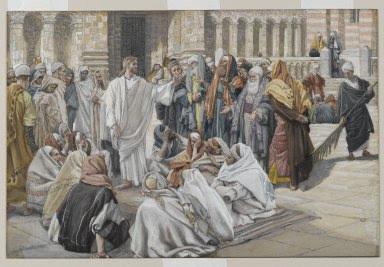
So what exactly are the rules for Christian living? Is the bible a 'moral authority'?

Billede
James J. Tissot - Pharisees ask Christ about the Greatest Commandment "`Teacher, which [is] the great command in the Law?' And Jesus said to him, `Thou shalt love the Lord thy God with all thy heart, and with all thy soul, and with all thine understanding -- this is a first and great command; and the second [is] like to it, Thou shalt love thy neighbor as thyself; on these -- the two commands -- all the law and the prophets do hang.'" (Matt 22:36-40, YLT) I've stumbled into some discussions lately about Christian ethics (so-called). It's the usual 'yes, love, but ...' thing. For some reason some Christians want all kinds of rules, besides the commandment to love others. The bible, these people say, is a 'moral authority'. Hence they sometimes reiterate Matt 22:36-40, where Jesus explains a Jewish Pharisee that the great(est) commandments in the Law is to love God and your neighbor. But in order to know what it means to love God, the arg...

Who is my neighbour?

Billede
Jean-Francois Millet: The Good Samaritan It is, of course, a cliché that the world has become so globalized and communities so broken up, that we do not any longer know what our responsibilities are. The world has always been chaotic, ties broken and relationships distorted (at least since shortly after someone ate a fruit they would have better left alone). Knowing that there have always been problems doesn't solve the problems, however. People - philosophers, politicians, pastors, anyone - still seem bewildered (or are they just passing time?) about who exactly we have duties towards. Is my neighbour anyone, my family, nation, refugees, the guy on the street or the African kid in the television-box? When Jesus was once asked "Who is my neighbour?" (Luk 10:29) he gave the parable of the good Samaritan. We are used to reading the conclusion - that it was the Samaritan who was a neighbour for him who was wounded - not so much as an answer to the question "wh...