Opslag

Viser opslag med etiketten anabaptists

Exceptions to God's love? A thought on violence and salvation, Anabaptists, Yoder, Barth and Luther
Billede
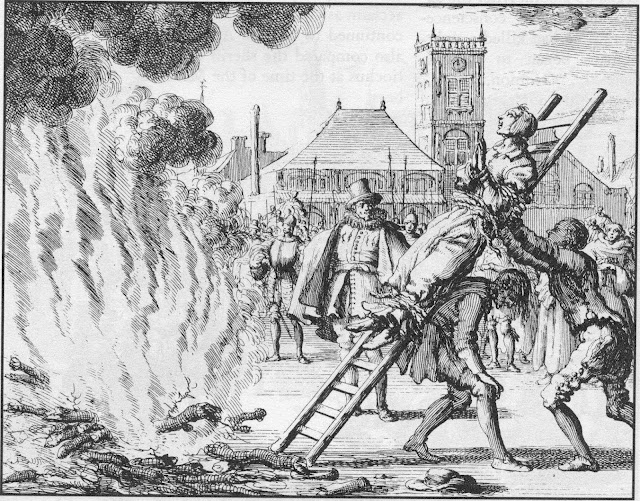
"Anabaptists" being tortured for rejecting violence and saying that there will be an end to otherworldly torture. In the Lutheran Augsburg Confession (CA) the so-called Anabaptists were condemned not just for their baptist practices but also for their views on eschatology, soteriology and ethics. First there is the Anabaptist rejection of violence. The Lutherans condemned the Anabaptists for teaching the necessity of not engaging as soldiers in “just war”, to “sit as judges” and to award “just punishments”. ”They condemn the Anabaptists who forbid these civil offices to Christians.” (CA § XVI) On soteriology we hear that Lutherans believe that the devil and sinners shall be tortured without end, while the Anabaptists are condemned for teaching that there will be an end to torture: ”They condemn the Anabaptists, who think that there will be an end to the punishments of condemned men and devils.” (CA § XVII) While the claim that there will be an end to punishments...

Hans Denck (1500-1527): Gelassenheit (yieldedness) as the solution to the problem of the (un)free will and evil.

Billede
Hans Denck 1500-1527 While Erasmus of Rotterdam (1466-1536) defended the idea that human beings have a free will to choose the good (anti-determinism), Martin Luther (1483-1546) defended the Augustinian idea that the human will is determined by God, and is thus unfree (determinism): God is 'absolute' and 'necessary', and thus determines human beings who are 'relative' and 'contingent' ( On the Bondage of the Will ). There is a third option, however.

Doing fellowship: A pragmatic perspective on the Lord's Supper

Billede
“According to the Gospel, God is not confined to the sanctuaries of the Church. He is not enshrined in any altar. The reason Christians gather now and then in their sanctuaries is not because God is there but rather to celebrate and proclaim God’s presence and action outside the sanctuaries in the common life of the world. Worship which has integrity in the Gospel is always an intercession by God’s people for the cares and needs of the world, and always a thanksgiving - a eucharist - for God’s love for the world. Worship at the altar is thus authenticated by the constant involvment of the people of the Church in the world’s life and by the public witness of the Church in the world.” (William Stringfellow) It might seem strange to want to base an ecumenical argument upon the views of ‘sectarians’. But by formulating an ecumenical view on the eucharist with reference to anabaptists such as Menno Simons, this is, to some degree, what the following proposes. There can be no dou...