Opslag

Viser opslag med etiketten Barth

Exceptions to God's love? A thought on violence and salvation, Anabaptists, Yoder, Barth and Luther
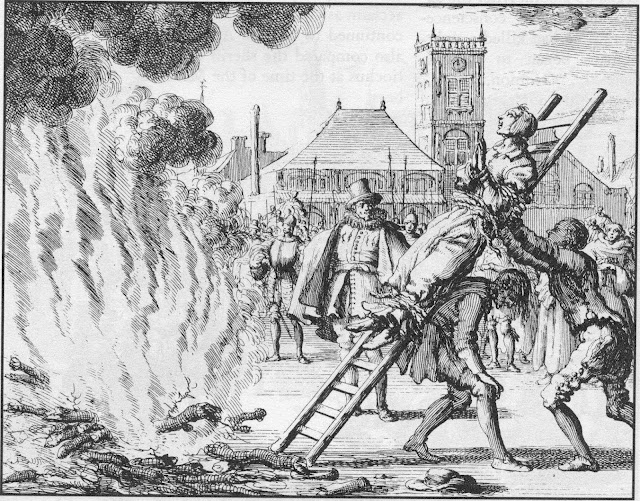
Billede
"Anabaptists" being tortured for rejecting violence and saying that there will be an end to otherworldly torture. In the Lutheran Augsburg Confession (CA) the so-called Anabaptists were condemned not just for their baptist practices but also for their views on eschatology, soteriology and ethics. First there is the Anabaptist rejection of violence. The Lutherans condemned the Anabaptists for teaching the necessity of not engaging as soldiers in “just war”, to “sit as judges” and to award “just punishments”. ”They condemn the Anabaptists who forbid these civil offices to Christians.” (CA § XVI) On soteriology we hear that Lutherans believe that the devil and sinners shall be tortured without end, while the Anabaptists are condemned for teaching that there will be an end to torture: ”They condemn the Anabaptists, who think that there will be an end to the punishments of condemned men and devils.” (CA § XVII) While the claim that there will be an end to punishments...

The violent or the loving God and the question of (un)limited atonement. Or: are Arminianism and Calvinism on the same (wrong) side of things?

Billede
Jesus with a sword in his mouth. Not in his hand. When we discuss the atonement there are two issues which seem quite unrelated. The one is the traditional discussion within protestantism on whether the atonement is limited or unlimited (i.e. did Jesus die for the salvation of all human beings, or only the elect?). The other is the question whether Jesus died as a payment to an angry God (protestantism) on the one hand, or whether he was God's ransom paid to death (not God) out of love, thereby defeating death, on the other (classical, pre-medieval Christianity).

What is liturgy?

Billede
"Liturgy (Greek: λειτουργία) is the customary public worship done by a specific religious group, according to its particular traditions." (Wikipedia) "“Be dressed ready for service and keep your lamps burning, like servants waiting for their master to return from a wedding banquet, so that when he comes and knocks they can immediately open the door for him. It will be good for those servants whose master finds them watching when he comes." (Luke 12:35-37) What is the function of liturgy? Why do people in Church play music, sing songs? Why sometimes dress in certain ways, put up pictures, use certain symbols and so on? What is the right way of doing worship? Such questions are eagerly discussed nowadays.

The 'real': Is it 'now' or the 'futurum aeternum'?

Billede
Clocktower in Prague. A friend recently posted this quote on Facebook: “The present moment is all that is real. The past is gone. The future is not yet. We remember the past and anticipate the future, but we always do so in the present. Reality is always now...” (Greg Boyd, Present Perfect) I have much good to say about Boyd (and I haven't read the book, it might be good, who knows). But I believe that Boyd here relies on a tradition of thought that is deeply problematic. This way of thinking about time can at least be traced back to the Platonism of Augustine: “How can the past and future be, when the past no longer is, and the future is not yet? As for the present, if it were always present and never moved on to become the past, it would not be time, but eternity.” (Augustine of Hippo, Confessions)

Ancient and modern views on the cosmological and political meaning of prayer

Billede
Yet one of those blog-posts that are "to be updated" as  I find more quotes on the subject matter. There is a tendency to think of prayer as a mechanism of obtaining things. You ask, you receive. God is imagined to be some sort of cosmic mechanical dispenser. You put in prayer, you get something, whatever, out. Of course it has to be honest prayer from a pure heart, and so on. We also tend to think of prayer as an initiative we take in order to get God's attention. But what we forget is that the only prayer acceptable to God is the one animated by the Spirit.

Nein!(?) A negative "point of contact" in the Epistle to Diognetus?

Billede
Still working on The Epistle to Diognetus , which keeps making associations to modern theology pop up. This time it's Karl Barth's debate with Emil Brunner. Consider the epistle's claim that, “[...]being convicted in the past time by our own deeds as unworthy of life, we might now be made deserving by the goodness of God, and having made clear our inability to enter into the kingdom of God of ourselves, might be enabled by the ability of God.” (9.1, Lightfoot) and “Having then in the former time demonstrated the inability of our nature to obtain life, and having now revealed a Saviour able to save even creatures which have no ability, He willed that for both reasons we should believe in His goodness[...]” (9.6, Lightfoot) If by 'dialectical theology' we mean that God's 'yes' and 'no' are inseparable (Tillich), this is certainly a specimen of such. The two elements, negative and positive, come together in faith (in an Aufhebung! ), or? A...

"[...]human logic always tends to arrange its propositions in a series and to leave out of account what is not pro-posed[...]"

"In spite of innumerable warnings, human logic always tends to arrange its propositions in a series and to leave out of account what is not pro-posed, which is in fact the pre-supposition of all pro-positions. In speaking of God, human logic characteristically ignores both His nature and the fact that, when the reference is to Him, the argument from operation to cause is inapplicable, since He is not a known thing in a series of things." (Barth, Epistle to the Romans, p. 82)

"[...]only dialectical thought can lead to genuine reflection upon its meaning and make sense of it."

"Things are simple and straightforward and obvious only when they are detached from their context and then treated superficially. The reality to which life bears witness must be disclosed in the deep things of all observable phenomena, in their whole context-and in their KRISIS. Only dialectical human thinking can fulfil its purpose and search out the depth and context and reality of life: only dialectical thought can lead to genuine reflection upon its meaning and make sense of it. For when our thought moves onwards direct and unbroken, when it is comprehensive, it is quite certain that we are not thinking about life;" (Barth, Epistle to the Romans, p. 425)

"The fact that ethics constitutes a problem reminds us that the object about which we are conversing has no objectivity [...]for we are not metaphysicians."

"The fact that ethics constitutes a problem reminds us that the object about which we are conversing has no objectivity, that is to say, it is not a concrete world existing above or behind our world; it is not a treasury of our spiritual experiences; it is not even some transcendental vastness: for we are not metaphysicians. Our conversation is about men living in the world of nature and of civilization; and, moreover, we ourselves are also men living of necessity from minute to minute a quite concrete life." (Barth, Epistle to the Romans, p. 424)