Opslag

Viser opslag med etiketten Gregory of Nyssa

The apophatic un-kingdom of God
Billede
“There is one true and perfect power which is above all things and governs the whole universe. But it rules not by violence and tyrannical dictatorship, which inforces the obedience of its subjects through fear and compulsion." ( Graff, St. Gregory of Nyssa, the Lord’s Prayer, the Beatitudes (Paulist Press; 1953), p. 51) Though Gregory of Nyssa does not present what we would today consider a systematic political philosophy, he frequently criticizes political power, domination and violence. The homilies on the Lord’s Prayer are no exception. The Kingdom of God does not rule by “violent kingship” or “tyrannical dictatorship”, enforcing the obedience of its subjects through “fear and compulsion”, says Gregory. When we pray for the Kingdom of God, we pray that the “good power” which already governs the whole universe will free us from the tyranny of the Devil through the Holy Spirit. A similar line of thought appears in Gregory’s homilies on the Beatitudes. The Kingdom o...

What is liturgy?

Billede
"Liturgy (Greek: λειτουργία) is the customary public worship done by a specific religious group, according to its particular traditions." (Wikipedia) "“Be dressed ready for service and keep your lamps burning, like servants waiting for their master to return from a wedding banquet, so that when he comes and knocks they can immediately open the door for him. It will be good for those servants whose master finds them watching when he comes." (Luke 12:35-37) What is the function of liturgy? Why do people in Church play music, sing songs? Why sometimes dress in certain ways, put up pictures, use certain symbols and so on? What is the right way of doing worship? Such questions are eagerly discussed nowadays.

The 'real': Is it 'now' or the 'futurum aeternum'?

Billede
Clocktower in Prague. A friend recently posted this quote on Facebook: “The present moment is all that is real. The past is gone. The future is not yet. We remember the past and anticipate the future, but we always do so in the present. Reality is always now...” (Greg Boyd, Present Perfect) I have much good to say about Boyd (and I haven't read the book, it might be good, who knows). But I believe that Boyd here relies on a tradition of thought that is deeply problematic. This way of thinking about time can at least be traced back to the Platonism of Augustine: “How can the past and future be, when the past no longer is, and the future is not yet? As for the present, if it were always present and never moved on to become the past, it would not be time, but eternity.” (Augustine of Hippo, Confessions)

Gregory of Nyssa on the atonement

"After we had thus freely sold ourselves to the deceiver, He who of His goodness sought to restore us to liberty could not, because He was just too, for this end have recourse to measures of arbitrary violence. It was necessary therefore that a ransom should be paid, which should exceed in value that which was to be ransomed; and hence it was necessary that the Son of God should surrender Himself to the power of death. God's justice then impelled Him to choose a method of exchange, as His wisdom was seen in executing it.” (Great Catechism)

Why "contra fatum"?

Billede
Gregory of Nyssa Contra Fatum ( lat. against fate , death or the speech of the gods ) is the Latin title of the Church father Gregory of Nyssa's (c. 335-394 ) short treatise against fatalism . Gregory defended the doctrine of free will ,  rejecting the belief that human destiny is determined by the celestial movements . Analogously, this blog is intended as a criticism of modern rationalism (s), whether in the form of political, technological, sociological or economical abstractions (modern astrology!), religious or spiritual-metaphysical ideas such as divine predestination and determinism. All lack a sense that human beings are created in the image of God , with freedom, infinite value , and a reason that cannot be reduced to the formulas of rationalism . Christus Victor! On the positive side the blog is a defense of the classical idea of the atonement effected by the incarnation, life, death and resurrection of Jesus Christ: Rather than ...

Creativity and the Ethics of Productivism

Billede
In danish we have an idiom which literally means “to create oneself” 1 but in daily use means being childish, losing one’s head or simply being mad. With a modern view on human nature this seems to be non-sensical. Do we not create ourselves constantly—isn’t that the meaning of life? In times where the greatest political challenge by many is believed to be the ”creation” of “economic growth,” and where “personal identity” is a product we create out of nothing in order to sell ourselves on the job market or in the social life, a negative answer to this question seems to contradict every tenet of common sense. But then again, isn’t it mad to think that we actually “create” our own selves ex nihilo—or anything at all for that matter? Answering questions such as these are important for understanding and countering the prevalent ideology of growth, or productivism. One (traditional) explanation for the power of the ideology of economic growth, is that branding and commer...

Gregory of Nyssa and the Absurdity of Political Justice

Billede
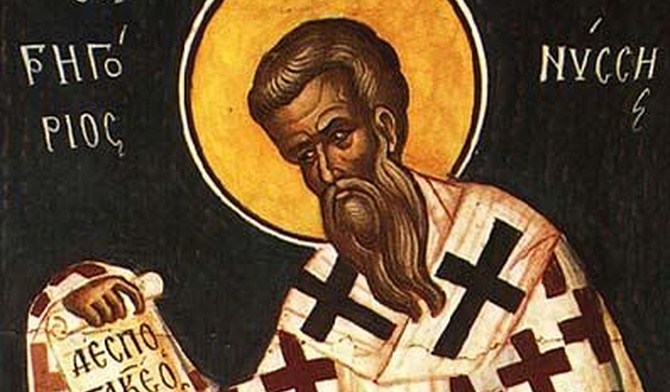
Gregory of Nyssa (c 335 – after 394) was a bishop in the Roman region of Cappadocia (in what is now Turkey), and, along with his brother Basil and his friend Gregory Nazianzus, he is considered one of the so-called “Cappadocian Fathers”. Gregory of Nyssa is perhaps most famous for his defence of the doctrine of the Trinity, as well as his speculative thoughts on metaphysics and moral perfection. He was the first clearly to claim the infinity of God – a notion which led him to his celebrated idea of epektasis (eternal progress in virtue). In his views on human nature Gregory emphasized freedom, and for this reason Nikolai Berdyaev (Orthodox philosopher and critic of state power), held that Gregory came closest to formulating a true Christian anthropology in his time. While political thought did not have a very prominent place in Gregory’s work, he does have some interesting reflections on the issue of justice – reflections that seem to distance him from his alm...